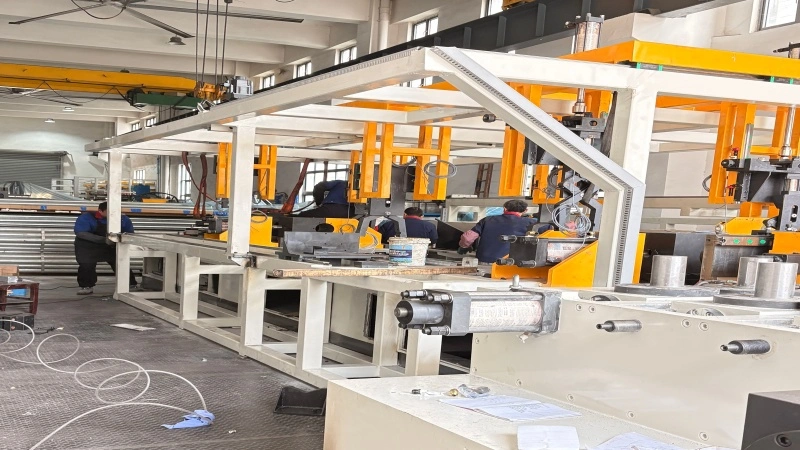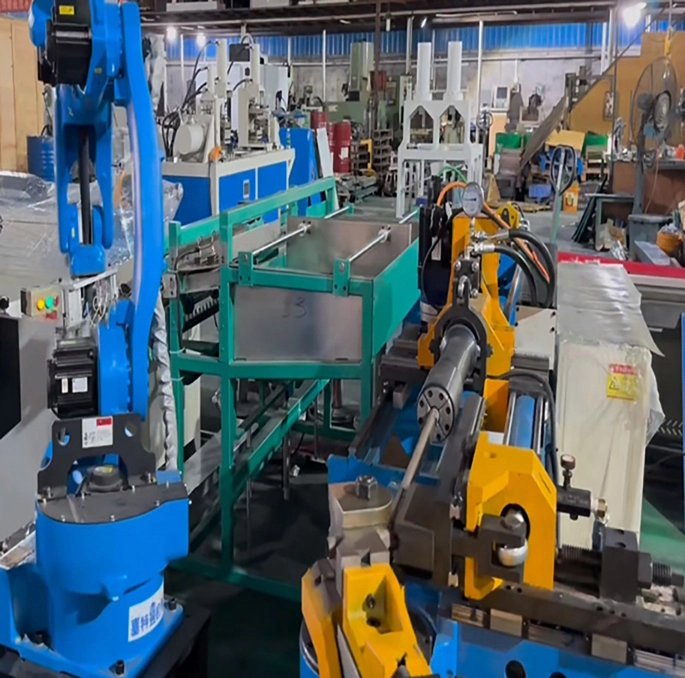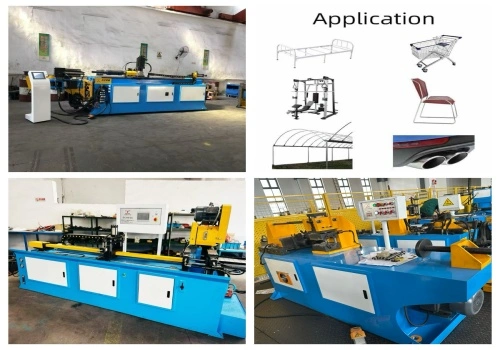
We focus on industrial-grade CNC pipe benders (CNC servo type). Compared with traditional manual/semi-automatic pipe benders, our products boast prominent advantages in core dimensions including machining precision, production efficiency and operational adaptability. They are suitable for processing common pipe materials such as steel pipes, aluminum pipes and copper pipes, and meet the production needs of factories as well as the selection demands of foreign trade customers.
1. High machining precision and excellent consistency of finished products
The CNC system precisely controls the bending angle, radius and feeding length with a repetitive positioning accuracy of ±0.1° to ±0.3°. The pipe material shows no significant flattening or wrinkling, and the finished products feature uniform dimensions in batch processing without the need for subsequent secondary correction, meeting the processing requirements for high-precision components.
- Tight Tolerances for Structural Integrity:
- CNC bending ensures that tubular arms maintain consistent radii and angles, preventing sagging or misalignment over time. This level of accuracy is critical for outdoor installations exposed to wind, vibrations, or impacts.
- Protective grilles for security windows or server racks demand uniform spacing between bends to prevent intrusion while maintaining airflow. CNC machines can replicate these patterns repeatedly, eliminating human error in manual bending processes.
2. Increased Efficiency and Reduced Production Costs
CNC pipe bending machines streamline manufacturing by automating repetitive tasks, reducing labor costs, and minimizing material waste. These efficiencies are particularly valuable in high-volume security equipment production.
- Faster Cycle Times and Higher Throughput:
- Unlike manual bending, which requires operators to measure, mark, and adjust tools for each bend, CNC machines follow pre-programmed instructions to complete bends in seconds. This automation accelerates production cycles, allowing manufacturers to meet tight deadlines without sacrificing quality.
- For example, producing batches of identical surveillance pole brackets becomes a one-click process once the CNC program is finalized, eliminating the need for re-measurement between parts.
- Material Optimization and Waste Reduction:
- CNC bending software calculates the most efficient way to cut and bend pipes from raw stock, minimizing offcuts and scrap. This is especially important for security equipment made from expensive materials like stainless steel or aluminum, where material costs can significantly impact profitability.
- By reducing waste, manufacturers can lower per-unit costs and improve sustainability—a growing concern in industries like security, where clients increasingly prioritize eco-friendly solutions.
- Reduced Labor Dependency and Skill Requirements:
- Manual bending requires highly skilled operators to achieve consistent results, and training new personnel can be time-consuming. CNC machines, on the other hand, are operated by technicians who need only basic programming knowledge, freeing up skilled labor for more complex tasks like quality control or R&D.
- This shift also reduces the risk of production delays due to staff shortages or turnover, as CNC programs can be stored and reused indefinitely.
3. Enhanced Durability and Reliability of Security Products
Security equipment must withstand harsh environments, tampering attempts, and prolonged use without failing. CNC pipe bending contributes to product longevity by ensuring structural soundness and resistance to wear.
- Consistent Bend Quality for Stress Distribution:
- Manual bending can introduce micro-cracks or uneven wall thickness in pipes, weakening the final product. CNC machines apply controlled force during bending, maintaining uniform material properties throughout the bend radius. This reduces the risk of fatigue failure in components like bollard frames or camera pole supports, which are subject to repeated stress from impacts or vibrations.
- For example, a security gate hinge bent with a CNC machine will have smoother transitions between straight and curved sections, minimizing stress concentrations that could lead to premature breakage.
- Corrosion Resistance Through Clean Bends:
- CNC bending produces cleaner finishes with fewer surface imperfections compared to manual methods. This is crucial for outdoor security equipment exposed to rain, humidity, or salt air, as rough bends can trap moisture and accelerate corrosion.
- Smooth bends also improve the effectiveness of protective coatings (e.g., powder coating or galvanization) by providing a uniform surface for adhesion, extending the lifespan of components like perimeter fencing or lighting poles.
- Repeatability for Standardized Security Solutions:
- Security systems often rely on standardized components to ensure compatibility across installations. CNC bending guarantees that every batch of parts—whether for a nationwide surveillance network or a multi-site access control system—meets the same specifications, reducing installation errors and maintenance costs.
- For instance, a manufacturer producing security grilles for data centers can use CNC bending to ensure that every grille fits the exact dimensions of server rack openings, preventing gaps that could compromise physical security.
4. Flexibility to Adapt to Evolving Security Needs
The security industry is constantly evolving, with new threats driving demand for innovative products. CNC pipe bending machines provide manufacturers with the agility to respond quickly to these changes without significant retooling or downtime.
- Rapid Prototyping for New Designs:
- When developing a new type of anti-ram barrier or drone detection tower, manufacturers can use CNC bending to create prototypes in hours rather than days. This accelerates the testing phase and allows for quick iterations based on feedback from security experts or end-users.
- The ability to program complex bends on-the-fly also supports customization for niche applications, such as bespoke security cages for high-value assets or modular fencing systems for temporary events.
- Scalability for High-Volume Orders:
- CNC machines can easily switch between small-batch production (e.g., a custom security gate for a VIP facility) and large-scale manufacturing (e.g., thousands of identical bollards for a city-wide infrastructure project). This scalability ensures that manufacturers can meet fluctuating demand without overinvesting in equipment or labor.
- By storing programs digitally, manufacturers can also quickly resume production of discontinued models if retrofitting or replacement parts are needed, ensuring long-term support for legacy security systems.
By leveraging the precision, efficiency, durability, and flexibility of CNC pipe bending machines, security equipment manufacturers can deliver products that meet the highest standards of performance, reliability, and adaptability. As the industry continues to innovate, CNC technology will remain a cornerstone of modern security manufacturing, enabling the creation of safer, more resilient solutions for clients worldwide.