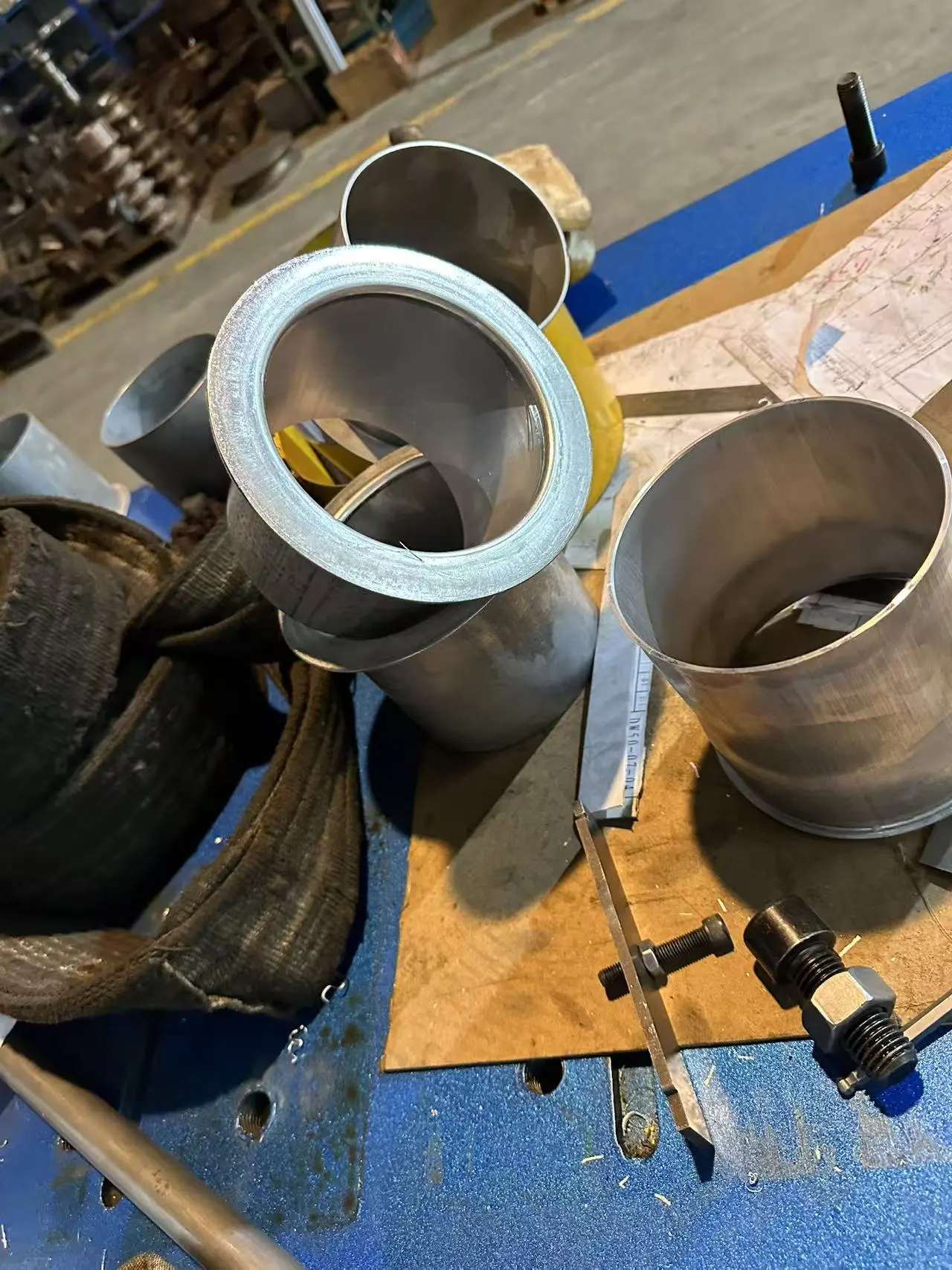
Many customers come to us with product concepts, samples or rough ideas, yet without finalized drawings or clear knowledge of whether a bending process is feasible.
Unlike the conventional model, customers provide requirements, ideas, samples or simple sketches, and our team conducts process evaluation, solution design, surveying and drawing, before moving forward with forming equipment customization.
In the non-standard tube bending industry, we often encounter this scenario:
A customer may only have an idea, a hand-drawn sketch or a handmade sample. They know the target shape, assembly application and surface requirements, but cannot specify bending radius, bending sequence, spatial rotation angle or tolerance standards. Nor do they know whether the part can be bent without flattening or collision, how many axes the bender needs, or whether mandrels and wiper dies are required.
If customers order equipment directly from machinery manufacturers at this stage, they risk fundamental flaws in drawings and unworkable processes. Problems are only discovered after the machine is built and trial bending begins, leading to repeated mold revisions, delivery delays and sharply higher costs.
Our service principle is to put process planning and drawing development upfront: customers submit their requirements, and we translate concepts into implementable technical documents.
- Cooperation Model: Customer Provides Ideas; We Deliver Solutions & Drawings
Acceptable inputs from customers include any of the following:
- Product concepts, application scenarios, assembly requirements and appearance expectations
- Physical samples, prototypes, rough sketches or photos
- Approximate dimensions, tube material, outer diameter, wall thickness, output and quality requirements
- Functional requirements: fluid pipelines, structural frames, decorative parts, fitting assembly requirements, etc.
Customers do not need to provide finished 2D engineering drawings or STEP 3D models, nor do they need to master tube bending processes in advance.
Deliverables from our team:
- Surveying of samples or conceptual shape development, feasibility assessment of forming; early identification of risks such as wrinkling, flattening, cracking, spatial interference and springback
- Confirm tube specifications, center-line bending radius, bending angles, straight segment lengths and 3D rotation angles
- Formulate forming process route: bending sequence, mandrel strategy, clamping positions, lubrication method, and whether pre-cutting, deburring, post-process piercing or end forming are required
- Create 2D engineering drawings with dimensions, tolerances, no-mark zones and acceptance requirements; provide matching 3D models
- Issue a complete process proposal including quality standards, ovality, angular tolerance and surface specifications
- After drawings and process plans are confirmed and frozen, we proceed with tube bender and mold customization, and share finalized documents with equipment suppliers as manufacturing references
Key Pain Points This Model Solves - Avoid inherent design defects caused by limited bending process knowledge
Drawings made by clients often feature an overly small bending radius, insufficient straight clamping length or inherently conflicting bending sequences. The shape may look good on paper but cannot be bent in reality. We apply bending constraints during the design phase. - Unified technical baseline to reduce disputes among stakeholders
All solutions, drawings and quality standards are issued and confirmed with the customer. They serve as consistent references for sampling, mold making and bender customization. - Validate before equipment investment to cut trial-and-error costs
Process reviews and simulation risk checks are completed upfront. If a shape is difficult to form, we propose optimization options. Customers may choose to adjust product geometry or forming process accordingly. - Balance functionality and mass production stability
Designs satisfy not only geometry, but also assembly, welding, surface finish and consistency for batch production, rather than working only for one-off prototypes. - Standard Workflow
- Requirement communication: Customers describe product intent and application, provide samples, sketches or photos, and clarify production volume, budget, precision and appearance requirements
- Surveying & preliminary process review: We measure samples or develop shapes based on concepts, assess forming difficulty and share risks and alternative options
- Draft solution delivery: Forming strategy, structural suggestions and preliminary dimensions for customer shape verification
- Formal drawing release: 2D engineering drawings + 3D models with tolerances, tube specifications and forming acceptance specifications
- Final approval: Customer confirms drawings and process plan for document locking / sample sign-off
- Downstream implementation: Proceed with bender & mold customization, trial sampling and mass production based on approved documents
- Suitable Application Scenarios
New product R&D and sampling, complex 3D bent tubular parts, frames, guardrails, sanitary piping, fluid lines, furniture tubular components. Ideal for customers with creative product ideas but limited in-house tube bending engineering and drawing capability.
FAQ
Q1: I only have photos or hand sketches without dimensions. Can you help?
A: Yes. We first discuss the shape and working conditions based on photos or sketches. Sending a physical sample for surveying is preferred. If no sample is available, we create a conceptual proposal and refine dimensional drawings after shape confirmation.
Q2: Can I still modify the product shape after the solution and drawings are confirmed?
A: Revisions can be made free of charge before formal locking. Once drawings and process plans are signed off and frozen, further changes will require re-surveying, simulation and process re-evaluation. We will notify you in advance of any related lead time and cost adjustments.
Q3: Does your drawing and process service include tube benders and molds?
A: Surveying, drawing and process planning are technical consulting services. Bending machines and tooling are separate items. We can coordinate with qualified equipment manufacturers, who will build machinery strictly following our approved process plan.
Q4: Can you develop process plans for thin-wall tubes, tight-radius bending or mirror-finish stainless decorative tubes?
A: Yes. These are typical projects we handle. At the solution stage, we define strategies for anti-wrinkling, anti-flattening and scratch prevention, and confirm mandrel, lubrication and mold selection.
Q5: How long does it take to deliver a full solution and drawing set?
A: Simple 2D bent parts usually take 2–3 working days. Complex multi-plane 3D bent components requiring bending simulation and risk assessment normally take 3–7 working days, subject to part complexity.
Closing Remarks
The foundation of reliable tube forming lies not in equipment itself, but in a sound process and drawing package.
We act as your technical partner for tubular forming: Bring us your ideas and requirements, and we handle surveying, solution design, drawing and process planning, to smoothly turn your concept into stable mass production.