:Based on Xingyu machinery catalogue: NC = WNC hydraulic numerical‑control series; CNC = full servo CNC pipe bending machine. Many customers confuse NC(WNC) and CNC, the core gap lies in axis drive mode, automation, 3D bending capacity instead of just names.
What is a CNC Pipe Bender?
A CNC pipe bender (Computer Numerical Control) is a full-automatic 3-axis servo bending machine.
t is equipped with three independent servo axes:
- Y-axis: automatic feeding
- B-axis: automatic tube rotation
- C-axis: automatic bending
After programming the tube data, the machine automatically feeds, clamps, bends, rotates, and finishes multiple complex bends in one cycle.
CNC benders support both 2D flat bending and 3D spatial tube bending, ideal for high-precision and mass production.

What is an NC Pipe Bender?
An NC pipe bender (Numerical Control) is a semi-automatic hydraulic bending machine.
Only the bending angle has digital control.
Tube feeding length and tube rotation must be done manually.
NC machines can only process simple 2D flat tubes, no 3D bending capability. Low cost and easy operation for small-batch jobs.
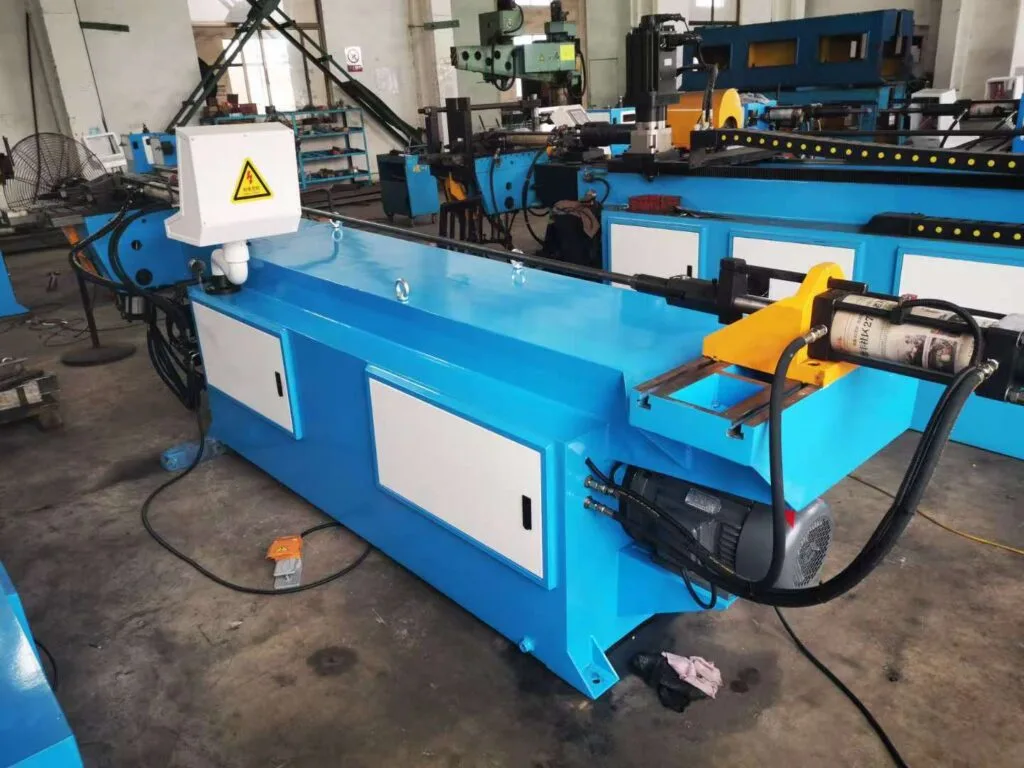
Core Difference Comparison Table
| Item | NC (WNC Hydraulic NC Pipe Bender e.g.DW50WNC) | CNC Servo Pipe Bender e.g.DW50‑1‑2CNC |
|---|---|---|
| Drive for each axis | Bending action: hydraulic;Feeding(Y‑axis): manual / hydraulic semi‑auto;Pipe rotation(B‑axis): manual | Bending(C‑axis): hydraulic;Feeding(Y‑axis): servo motor;Pipe rotation(B‑axis): servo motor |
| 3D spatial bending | ❌ Not support. Only 2D planar bending.No automatic pipe rotation. Operator rotates tube by hand. | ✅ Full 3D bending. Y/B axis servo automatic feeding & rotation. Complete multi‑plane complex parts in one clamping |
| Programming & storage | Micro‑computer, only store bending angles.Max 20 bends per tube. No coordinate conversion. | Touch‑screen PLC+Windows system. Store 1000+ part programs. Support XYZ ↔ YBC coordinate auto‑conversion. Each bend can set independent speed & compensation value |
| Repeat accuracy | Angle accuracy ±1°~±2°, manual operation error exists | Angle tolerance ±0.05°~±0.15°, stable repeat accuracy for mass production |
| Operation mode | Manual loading; feeding & rotate pipe manually; semi‑automatic bend cycle | Auto feeding + auto rotate tube; full‑auto cycle after program input. Only manual loading raw pipe |
| Mandrel function | Basic manual mandrel retract | Optional automatic mandrel lubrication & pre‑retract function |
| Optional extra functions | Few optional items | 3D simulation, machine interference check, 4G remote diagnosis, multi‑layer die shifting |
| Production scenario | Low‑medium volume; simple 2D parts; carbon steel handrail, simple frames | Mass‑production; complex 3D parts: automotive exhaust, chassis, seat frames, stainless thin‑wall tube |
| Investment cost | Lower price, economical choice | Higher initial investment, save labor cost for mass orders |
Practical Selection Tips
- NC(WNC) can only set bending angle value, cannot control feeding length and rotation angle automatically.
- Do NOT be misled by marketing name: many sellers call hydraulic NC “CNC”, check whether feeding and rotation axes are driven by servo motor.
- If your workpiece needs to bend on multiple different planes, you must choose real servo CNC pipe bender; NC cannot finish automatically.
Real Differences between NC(WNC) and CNC Pipe Bending Machine
Q1: What does NC (WNC) pipe bender stand for? Is it CNC?
A: In our pipe machinery industry, NC / WNC refers to hydraulic numerical‑control bender. Only bending angle is digitally controlled. Feeding and pipe rotation are manual/hydraulic, NO servo motor. It is NOT real CNC machine.
Q2: What is the most essential real difference between NC(WNC) and CNC pipe bender?
A: Whether feeding(Y‑axis) and pipe rotation(B‑axis) adopt servo motor. ‑ NC(WNC): No servo for feeding & rotation, manual operation. Only bending angle is digital set. ‑ Real CNC: Y‑feeding and B‑rotation are driven by servo motor, fully automatic movement after programming.
Q3: Can NC(WNC) machine make 3D spatial bent pipe parts?
A: Not automatically. You need to take out the tube and manually rotate it between each bend. Poor consistency, low efficiency, easy human error. For mass‑production 3D workpieces, servo CNC is required.
Q4: Can NC(WNC) and CNC reach same angle precision?
A: No. NC angle tolerance approx ±1~±2° due to manual feeding / rotating. Real servo CNC reaches ±0.05°‑±0.15°, stable repeat accuracy for batch parts.
Q5: My parts are 2‑D planar bending only, should I buy CNC?
A: If batch size is small‑medium, NC(WNC) hydraulic NC is cost‑effective. If you run very high volume even for 2D parts, CNC still helps save labor and improve consistency.
Q6: Some suppliers name hydraulic NC machine as “CNC”, how to identify real CNC machine?
A: Ask two key questions:
- Is tube feeding driven by servo motor?
- Is pipe rotation (twist between bends) driven by servo motor? If both answers are “NO”, it is hydraulic NC(WNC), not real servo CNC bender.
Q7: What functions only real servo CNC machine can provide?
A: XYZ‑YBC coordinate conversion, storing thousands of part programs, independent speed / compensation for each bend, optional 3D simulation, mandrel auto‑lubrication, remote diagnosis, multi‑layer mould auto‑shifting. These functions are unavailable on NC(WNC).
Q8: For stainless‑steel thin‑wall tube bending, can I use NC(WNC)?
A: You can make samples, but not recommended for mass‑production. Manual feeding & rotation bring unstable dimension and surface scratches. Servo CNC plus matched mandrel & wiper die is preferred.
Q9: Which one has lower maintenance cost, NC or CNC?
A: NC(WNC) has simpler hydraulic system, lower maintenance requirement and lower spare‑part cost. Servo CNC requires regular maintenance for servo motors and electric control components.
Q10: How do I decide between NC(WNC) and CNC for my project?
A: ✅ Choose NC(WNC): Small‑medium batch, only 2‑D flat bending, budget sensitive, carbon steel handrail / simple frames. ✅ Choose CNC Servo: Mass‑production, multi‑plane 3D bending, strict dimension repeatability, stainless thin‑wall pipe, automotive / chassis / exhaust parts.