How to Select the Appropriate Machine Model?
Based on IMG Machinery official catalogue, covering WNC hydraulic NC series, CNC servo full‑automatic series, double‑head series, mould accessories and practical selection rules
Features
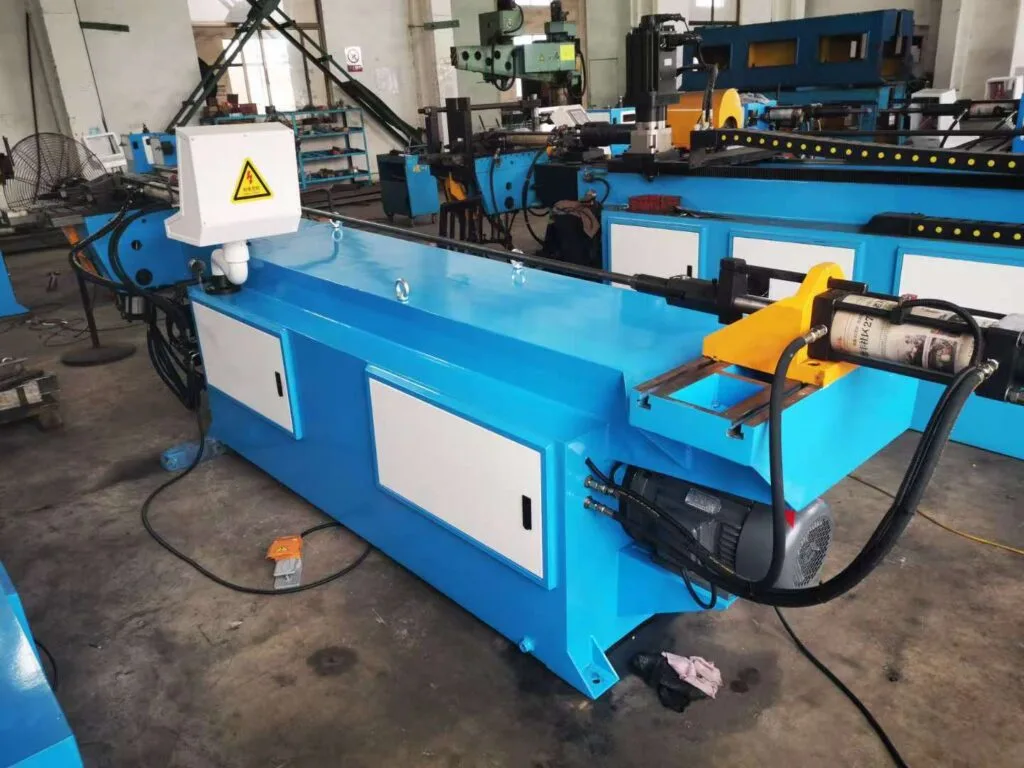
WNC Hydraulic pipe bending machine
1.Micro computer control, much stabilize machinerunning.
2.Has multiple functions for select freely atmanual,automatic,semicirculate andfulcirculate.
3.Eight angle setting (free optional at 0-185°),canbe single selection,also canbe two typescontinue selection.
4.Moveable pedal type switch, has threecontinuous functionsatautomatic startemergency stop and emergency stop continuoush电igh safety performance.
5.Big volume cooling circulate system, make themachine running more stabilize.6.More easyand simple renewal mouldconvenientfor elasticity produce
7.Machine head, exquisite pipe bending design.provide the max pipe bending space.
CNC Servo Pipe Bend Machine
Mechanical characteristics
1.Electric control system: adopt well known controller, example: servo driver, servo motor, etc, strong performance.
best stability.
2.PLC controller with touch screen, can do parameter setting, repeat feeding material, can store 1000 each produce
workpiece number. 3.industry used computer interior installed Windows task system match with Mitsubishi servo system. Except hasthe advantage of Mitsubishi servo drive, stil has the more better convenient performance at file management, alsocan save the files in hard dish or soft dish disk, infinite expand edit group number. 4.3D automatic simulate function(optional purchase) at pipe part moulding. 5.Has the automatically detect error and failure function, and display on screen, make the operator easy to solve the problem.
6.Machine interfere 3D automatic simulate function(optional purchase) 7.All produce datum input through touch screen.
8.Each one bending pipe can set the compensate value, speed and strip gap based on diferent material change. 9.Each bending of the same pipe all can singly draw five action sequence, 10 section speed, make the operatormatch use,improve the working efficiency.
10.The touch screen can do Chinese-English shift, the other languages can be orders according to requirements.
11.The material feeding method can select direct sending or clamp sending because the different selection.
12.Can automatic change the XYZ coordinate to be YBC produce value.
13.After finish edit the datum, save in touch screen directly, prevent datum been edited freely. 14.The electric control system configured heat exchanger automatic heat radiation, can optional purchase the Nc air cooling machine if need, make ensure the life of electric control system.
15.The machine additionally installed automatic fill oil system, can reduce the bend pipe rub, improve core bar’s workinglife, guarantee quality of bend pipe 16.The machine platform can additionally install communication interface and data machine. Because the 4G phone circuit of mobile phone on-line with our company so has engineer done remote operating and control, on time monitor, software update and troubleshooting, etc.
17.The setting of material feeding position of material transport trolley, safety position, transport module interfereposition, quide module interfere position can be manual micro adjust, and automatically remember the position,eliminate loss because the deemed measure error and machine impacted.
18.Material transmit shaft will automatically detect before action, avoid impact the machine. 19.Can select the resolve motions when solid bending, observe the interfere point, revise motion, improve efficiency.

1. Core technical parameters you must confirm before model selection
Please provide below pipe information for accurate model recommendation:
- Pipe material: carbon steel / stainless steel / aluminum / copper‑alloy. Stainless steel requires higher machine rigidity and scratch‑resistant tooling.
- Outer Diameter (OD) & Wall Thickness (WT): the decisive factor for machine model. Note: Same OD tube, thicker wall requires higher bending force; thin‑wall tube needs mandrel to avoid collapse & wrinkling.
- Bending Radius (R):
- Standard bend: R≥1.5D (D = pipe OD)
- Tight radius bend: R<1.5D → mandatory for mandrel + anti‑wrinkle die set
- Bending angle, quantity of bends per piece, 2D / 3D spatial bending requirement.
- Batch size: low‑volume / mid‑batch / mass‑production.
- Max raw pipe length for feeding, workshop floor space, local power supply condition.
Machine category comparison
| Machine Series | Model Code | Core feature | Typical Application |
|---|---|---|---|
| WNC Semi‑automatic Hydraulic NC | DW38WNC‑DW219WNC | Hydraulic drive, micro‑computer angle setting, manual loading, no servo feeding / rotation; store max 20 bends per tube; max bend angle 185° | Low‑medium volume, simple 2‑D bending, handrail, frame, carbon steel pipe; cost‑effective option |
| CNC Servo Full‑automatic | DW38‑1‑2CNC ~ DW219‑1‑2CNC | Servo controlled feeding(Y‑axis), rotation(B‑axis), hydraulic bending(C‑axis); touch‑screen, store 1000+ programs; XYZ‑YBC coordinate conversion; optional 3D simulation, remote diagnosis; bending tolerance ±0.15° | Mass‑production, complex 3D bent parts, automotive exhaust, chassis, stainless‑steel thin‑wall tube |
| Multi‑layer‑mould CNC Servo | Custom CNC model | Hydraulic up‑down / left‑right die shifting; support 1‑2 different bending radii in one setup | Products with mixed bending radii on one workpiece |
| Double‑head WNC | SW38 / SW50 | Two bending heads, bend both pipe ends at one time; standard / rotary‑type available | Short tube, both‑end bending, furniture & fitness equipment tubes |
| Double‑sided CNC | SDW251.5 / SDW501.5 | Support clockwise & counter‑clockwise bending, solve machine interference issue for complex workpieces | Complicated parts that single‑head machine cannot finish in one clamping |
Key difference summary
✅ WNC (Hydraulic NC): Good for simple planar bends, lower investment; feeding & pipe rotation operated manually. ✅ CNC Servo: Servo for feeding & rotation, full automatic 3‑D bending, high repeat accuracy for mass‑production.
3. Main model reference (extract from Xingyu catalogue, 1.5D bending radius as reference)
WNC Hydraulic NC Series
| Model | Max Carbon Steel Pipe | Max Stainless Steel Pipe | Motor Power |
|---|---|---|---|
| DW38WNC | Φ31.75×3.5t | Φ31.75×2.2t | 4KW |
| DW50WNC | Φ38.1×1.9t | Φ38.1×2.2t | 5.5KW |
| DW63WNC | Φ44.45×4.8t | Φ57.15×2.2t | 7.5KW |
| DW75WNC | Φ63.5×2.5t | Φ69.85×1.9‑2.2t | 11KW |
| DW90WNC | Φ76.2×2.1/2.5t | Φ88.55×1.8t | 11KW |
| DW114WNC | Φ114×6.0t | Φ101.6×3.0t | 15KW |
| DW168WNC | Φ150×8.0t | Φ125×4.0t | 30KW |
| DW219WNC | Φ219×12.0t | Φ219×6.0t | 45KW |
CNC Servo Series
| Model | Max tube capacity | Angle Accuracy | Main use |
|---|---|---|---|
| CNC38 | Φ32×1.8t | ±0.05° | Small furniture, hydraulic tubing |
| CNC50 | Φ45×2.0t | ±0.05° | Exhaust pipe, general precision parts |
| CNC63 | Φ63×3.0t | ±0.05° | Automotive & engineering pipe |
| CNC90 | Φ90×3.0t | ±0.05° | Medium‑large structural tube |
| CNC114‑CNC219 | Up to Φ219 | ±0.1° | Heavy‑duty large‑diameter pipe |
Real reminder: Do not select model only by OD; wall‑thickness shall be strictly checked, because heavy wall pipe will require larger tonnage machine.
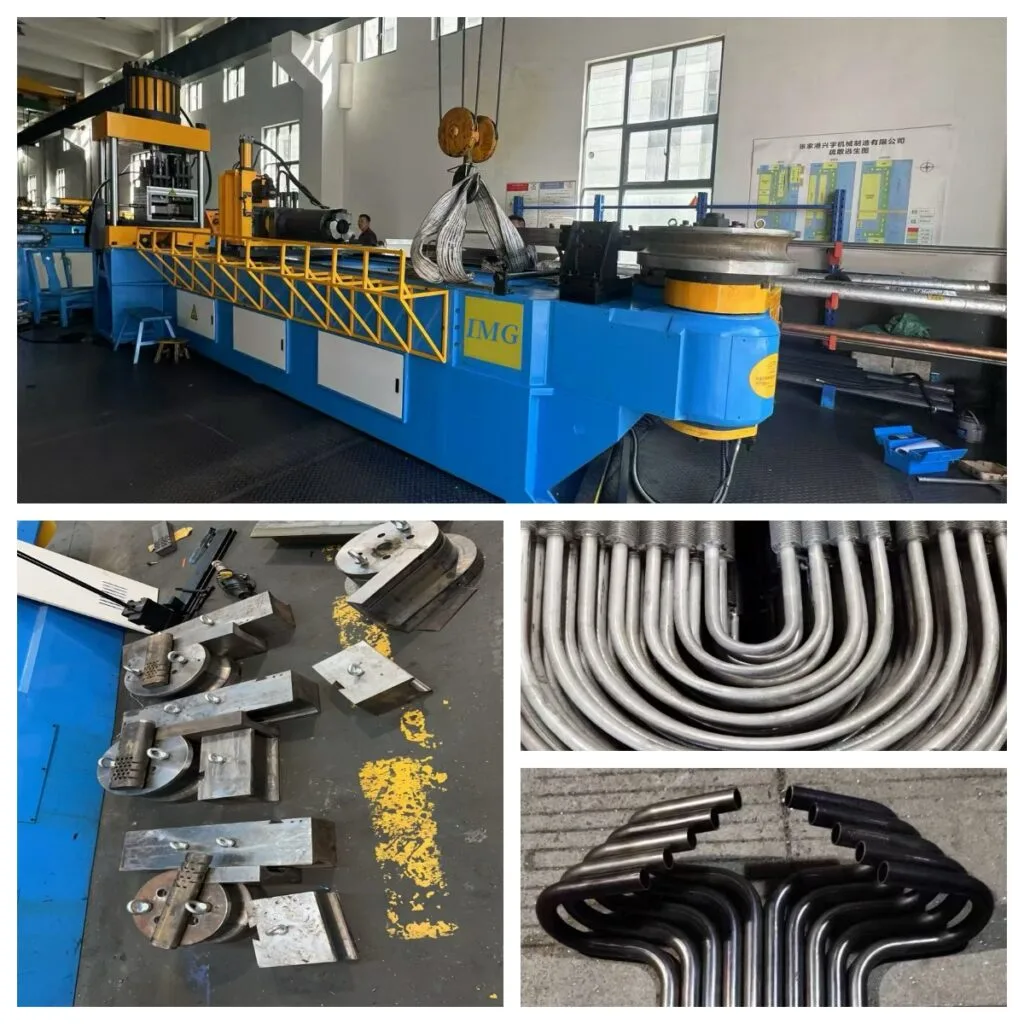
4. Tooling & auxiliary configuration selection
Moulds are consumables, custom‑made per tube OD & bending radius:
- Bend die: Main forming mould
- Clamp die: Clamp tube tightly during bending
- Pressure / wiper die: Prevent scratch, especially for stainless steel
- Anti‑wrinkle die: Eliminate inner‑side tube wrinkling
-
Mandrel series:
- Fixed mandrel: thick‑wall pipe
- Single‑ball mandrel: general thin‑wall
- Multi‑ball universal mandrel: tight‑radius thin‑wall bending
Mandrel + anti‑wrinkle die are mandatory for thin‑wall & R<1.5D application.
Optional machine accessories:
- Mandrel auto‑lubrication system: extend mandrel service life
- Air‑cooling / oil‑cooling system: for long‑time continuous running
- 3D simulation module: check machine interference before actual bending (optional)
- 4G remote access: remote diagnosis & software upgrade (CNC model optional)
5. Practical selection experience
- Carbon‑steel handrail, low‑volume, simple 2‑D bend: Choose WNC hydraulic NC model to save cost.
- Stainless‑steel thin‑wall tube with R ≤1.5D: Must select CNC servo model + ball mandrel + wiper + anti‑wrinkle die set to avoid wrinkling, flattening and surface scratch.
- 3‑D multi‑bend workpieces (chassis, exhaust, seat frame): Only full‑servo CNC machine can do; WNC is not suitable.
- Short tube with bends on both ends: Evaluate double‑head SW‑series for higher throughput.
- Multiple bending radii on one workpiece: Select multi‑layer mould CNC machine.
- Complex pipe causing single‑head machine interference: Choose double‑sided CNC machine with left‑&‑right bending function.
- Best practice: Send actual pipe sample or 2D drawing (OD, WT, material, bending radius, angle) for our technical team to confirm exact model and complete mould solution.
6. Other factors for final decision
- Power supply: confirm local 3‑phase voltage (380V or customized).
- Workshop layout: machine dimension plus space for raw pipe loading & unloading.
- After‑sales: Xingyu has nationwide service offices in China; oversea customers get remote support plus spare‑parts supply.
- Budget: WNC series lower investment; CNC servo higher cost but much higher efficiency & consistency for mass‑production.
If you have pipe drawing, send it over, we can fill a customized machine & tooling quotation for you.
FAQ
Q1: What core data do I need to provide for correct pipe bender model selection?
A: Please offer pipe material, outer diameter(OD), wall thickness(WT), bending radius(R), bending angle, bends per workpiece, production batch, max raw pipe length and workshop power condition. Pipe drawing or physical sample is highly recommended.
Q2: What is the main difference between WNC hydraulic‑NC and CNC servo pipe bender?
A: WNC is hydraulic drive with manual feeding and pipe rotation, fit for simple 2‑D bending and small‑medium batch production with lower cost. CNC servo model adopts servo for feeding, rotation and bending, supports complex 3D multi‑bend parts, higher precision & efficiency for mass‑production.
Q3: Can I choose machine model only according to pipe outer diameter?
A: No. Wall thickness is critical. Even for same OD, heavy‑wall pipe requires higher tonnage machine. Thin‑wall tube needs extra mandrel and anti‑wrinkle tooling.
Q4: When do I need mandrel and anti‑wrinkle die?
A: Mandrel together with anti‑wrinkle die are required for thin‑wall pipe or tight‑radius bending where R<1.5D. They prevent tube flattening, inner wrinkling and deformation during bending.
Q5: Which machine is better for stainless‑steel thin‑wall tube bending?
A: Choose CNC servo pipe bender. Equip with ball mandrel, wiper die and anti‑wrinkle die set, to avoid scratch, wrinkle and cross‑section distortion.
Q6: Which model for short tubes needing bends on both pipe ends?
A: Double‑head WNC series (SW38 / SW50). It completes two‑end bending in one clamping and improves output for furniture and fitness‑equipment tubes.
Q7: What machine to use if one pipe has multiple different bending radii?
A: Select CNC servo machine with multi‑layer mould function, which supports die shifting for 1‑2 different radii without frequent mould change.
Q8: My part causes machine interference on single‑head bender, what solution?
A: Adopt double‑sided CNC pipe bender (SDW series), which supports both clockwise and counter‑clockwise bending to solve interference problems.
Q9: Are bending moulds included in machine standard delivery?
A: Standard machine comes with one set of standard moulds for target pipe specification. Extra mandrel, wiper die, anti‑wrinkle die are optional consumable tooling customized per workpiece.
Q10: What after‑sales support can you provide for overseas clients?
A: We supply operation manual, video training, remote diagnosis for CNC models via 4G module, and fast spare‑parts delivery. Local service offices are available for domestic customers in China.
Q11: Can WNC hydraulic‑NC machine produce 3D spatial bent workpieces?
A: No. WNC series has no servo pipe rotation function. It can only handle 2‑D planar bending. For 3D multi‑angle spatial parts, CNC servo model is mandatory.